The Day I Finally Felt the Ground Again
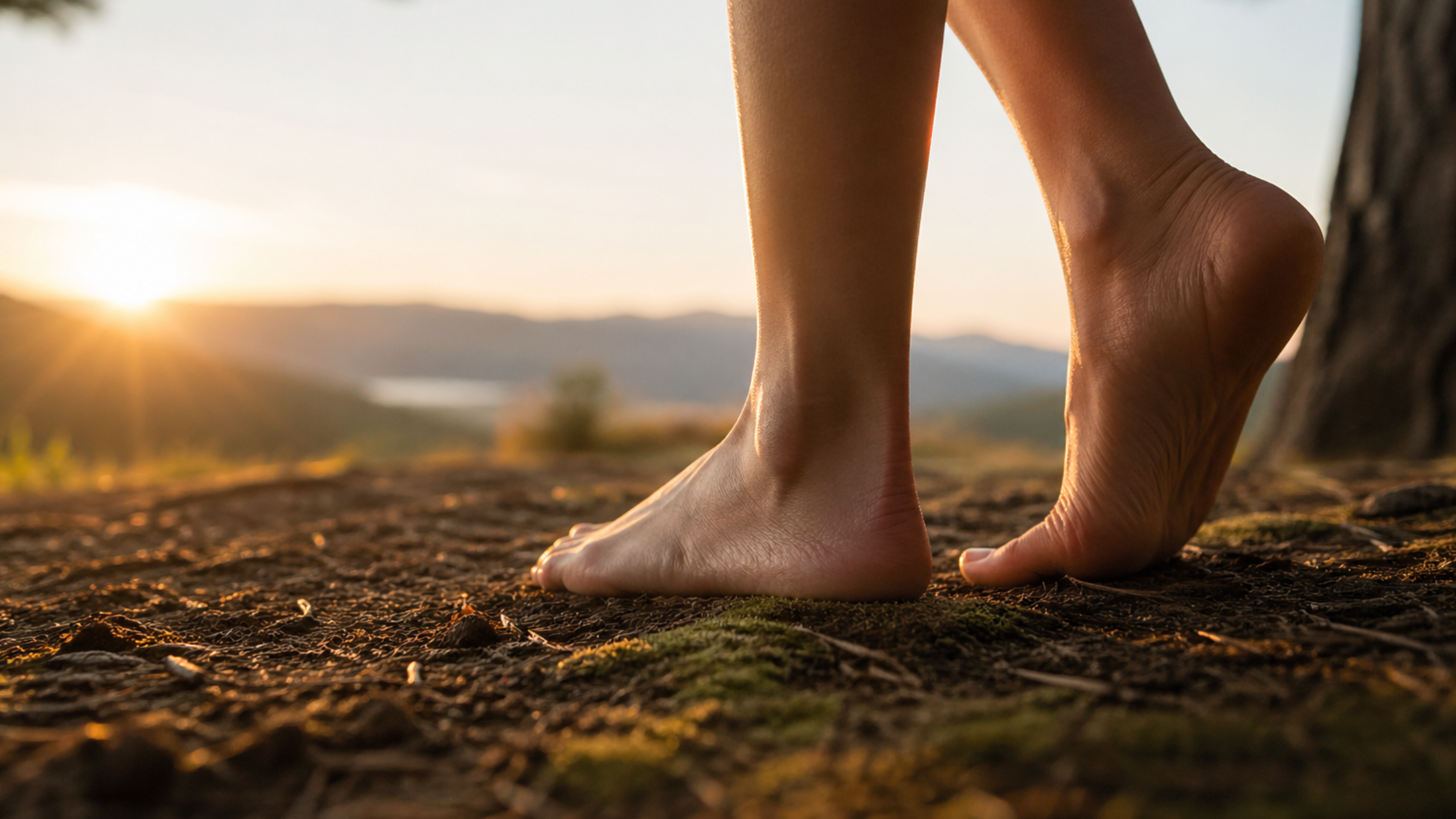
For years, I never felt fully rooted to the ground.
It sounds strange, but it always felt as if my body was pulling up and out of my feet rather than settling into them.
My feet felt stiff in the morning. Smooshed and splayed when I walked. Painful during long walks. And over time, I could tell my whole system was working harder than it needed to as a result.
I also noticed the shape of my feet changing.
My arches flattened when I walked. Distinct callous patterns developed on the bottoms of my feet. The outer tops of my feet became more prominent when I looked down from above.
Something was off.
Putting Together the Clues
At one point, I was diagnosed with hallux limitus in my left big toe joint — essentially a rigid, poorly functioning big toe that couldn’t fully descend into the ground or transfer force properly during gait.
The callous pattern on my foot confirmed it.
There was almost no callousing beneath the first metatarsal head of the big toe. Instead, the pressure was concentrated beneath the second, third, and fourth metatarsal heads, where my body was compensating for the missing function of the first ray.
That area became increasingly sensitive over time from carrying too much load.
I also developed tailor’s bunions on both feet, more pronounced on the left side.
The signs were all there: my feet weren’t organizing force correctly.
Frustration with Local Corrective Exercise
I kept trying to fix the problem locally, but I kept running into roadblocks.
Plantar fascia work and calf massage helped temporarily, but the gripping always returned.
Toe control exercises exposed how little granular control I actually had over my toes. Sometimes they barely responded to my mental commands at all.
Foot strengthening exercises felt limited because I could sense I was strengthening through compensation patterns instead of clean mechanics.
Mobility drills only worked if the talus and tibia were aligned correctly — and mine weren’t.
Even arch exercises like short foot felt muddy and overcompensated.
Some things helped a little.
But nothing truly changed the way force moved through my body.
Then something clicked.
I Needed to Look Beyond the Foot
A foot compensation is not always created in the foot.
If the pelvis and hips are mispositioned, the feet will adapt accordingly. And if the feet lose integrity, everything above them reorganizes around that instability.
So instead of trying to force change directly into my feet, I decided to move up the chain.
I sat on a Swiss ball with my knees bent and slightly apart. I held my outer toes down and focused intensely on the inner edge and upper surface of the big toes, trying to move them independently from the others.
At first it felt almost impossible.
Then I noticed something surprising:
To access the big toe correctly, my body above it had to reorganize.
My rib flare softened.
My shoulders dropped and integrated into my trunk.
The gripping in my lower back stopped.
And suddenly I could feel the first metatarsal head connect to the ground.
Not just touch the ground.
Connect.
Root.
The moment that happened, my arch formed naturally. My pelvis and glutes integrated more cleanly. My obliques turned on without force. My shoulders stopped hanging out of my neck.
It felt like my body finally found somewhere to land.
The Bull Stomp
Then I tried something else.
I started using a stomp of the feet — almost like a bull stomping the ground before it charges.
I got the idea after listening to Stalking the Wild Psoas: Embodying Your Core Intelligence by Liz Koch, where she discusses stomping as a way to help free the psoas and restore a sense of grounding.
The effect was immediate.
Instead of trying to micromanage posture, my body organized reflexively around pressure and force transfer. I could suddenly feel the connection from the feet into the pelvis, through the trunk, and up into the shoulders.
I then tested it under load. I did squats with 40 pounds and some hip hinge work, and the difference was incredible. The force flowed through my body cleanly instead of getting trapped in my usual gripping zones.
For the first time in a long time, movement felt springy instead of compressed. A previously dark area of my body had come back online.
Grounding Is Not Just a Wellness Buzzword
When the body loses a clear relationship with the ground, compensation starts happening everywhere.
Loss of this fundamental connection to the earth via a stable foot causes your body to search desperately for alternatives — gripping, bracing, hovering and over-control through other parts of the body all the way from the lower leg to the jaw.
Rememebr that everything is connected and a loss of function in one area of the body can create problems very far away.
In my case, this loss of foot stability likely caused my brain to adopt a top-down stability strategy - gripping at the neck and ribs and lower back, living in a pattern of extension because I wasn’t receiving support from the ground up.
The tension in my shoulders and lower back wasn’t separate from my foot mechanics. The gripping pattern was literally lifting me out of my feet.
And once my body trusted the ground again — specifically through the first metatarsal head — everything changed.
Returning to Running
This discovery feels especially important because it gives me hope that I may finally be able to return to running and jogging again.
Running is something I genuinely enjoy. It makes me feel alive, clear, connected, and free. It’s also one of the ways I like to support my cardiovascular health and manage my weight naturally.
But for the past five years, I’ve largely had to stop.
Every time I tried to return to running, my body issues would flare up. The twisting through my neck would increase, my upper neck and shoulders would tighten, my feet would become aggravated, and my whole system would fall back into compensation patterns that felt impossible to escape while moving at that speed and impact level.
It felt like my body could not organize around the impact and propulsion of running without collapsing into old strategies.
That’s why this experience felt so significant.
For the first time in years, I felt what it was like to connect to the ground through the first metatarsal head and allow force to move cleanly through my body instead of getting trapped in my usual gripping and compensation patterns.
And I realized something important:
I don’t think I’ve been missing running itself.
I’ve been missing the feeling of being fully connected while running.
The feeling of force moving cleanly through the body.
The feeling of trust.
Rhythm.
Propulsion.
Elasticity.
Freedom.
For the first time in a long time, I feel like I can begin the journey of running again — not by forcing my body through it, but by restoring the relationships that make running feel natural in the first place.
Not perfectly.
Not all at once.
But honestly, this felt like returning to a part of myself that has been waiting a very long time to come back online.