The Sacred Spiral of Progress

One of the most frustrating—and ultimately rewarding—things about learning to move well is realizing that progress is not linear.
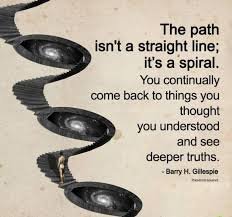
We often imagine growth as a straight line: learn a skill, master it, and move on to the next challenge. But in reality, progress rarely works that way. More often, it resembles a spiral. We return to the same concepts again and again, each time with a deeper level of understanding and a greater capacity to apply what we've learned.
Recently, I was reminded of this in a very personal way.
I realized I was still relying on a stability strategy that no longer served me. Not so much that it prevented me from exercising, teaching, or getting stronger, but enough that something felt slightly off.
I was still creating stability by gripping through my back and neck.
Over the years, I had developed a great deal of strength and control, yet there remained a subtle pattern of compression running through my system. Rather than creating stability through organization and connection, my body was still relying on shortening and holding.
As I revisited some of my foundational core and alignment work, I began to discover a different pathway.
I focused on creating more length through my torso. I found better support through my lateral line and reestablished the connection between the front of my pelvis and my waist. I allowed my shoulders to release from my neck and reconnect to the support coming from below.
As these pieces started to come together, something unexpected happened.
I noticed that I couldn't produce a clean biceps contraction in a position where my elbow was flexed and my shoulder was both flexed and abducted.
Most people would assume this was an arm problem.
I didn't.
Instead, I started investigating the shoulder.
I studied reference photos and compared them to my own anatomy. I looked for the hollowed appearance of the armpit, the firmness where the pec and anterior shoulder meet, and the connection between the rear delt and the lat. These landmarks helped me identify whether the shoulder girdle was truly organized.
What I discovered was that I wasn't fully connected to those points.
My shoulder blade wasn't truly anchored. So I reorganized.
I focused on anchoring the scapula and establishing those missing points of connection. Then I tried the biceps contraction again.
The difference was immediate.
The signal was stronger, cleaner, and far more obvious.
The biceps hadn't suddenly become stronger, the foundation beneath it had simply become more organized.
This is a pattern I see repeatedly in movement practice: People chase strength when what they really need is connection; they chase flexibility when what they really need is control; they chase more difficult exercises when what they really need is a better map.
The body is often not lacking capacity, it's lacking access.
Looking back, this discovery feels remarkably familiar because it mirrors so many other breakthroughs I've experienced over the years.
I had to organize my feet before I could truly find my glutes.
I had to organize my pelvis before I could access my obliques.
I had to organize my ribcage before I could breathe efficiently.
And now I had to organize my shoulder girdle before I could fully access my arm.
The lesson itself wasn't new.
I was.
What changed was my ability to perceive, organize, and connect.
Sometimes growth isn't about moving forward into something new. Sometimes it's about returning to the fundamentals with a more refined eye and a deeper level of awareness.
The most meaningful breakthroughs in movement often come not from discovering new lessons, but from revisiting old ones and realizing they still have something to teach us.