Why Do So Many of Us Have Foot Problems?
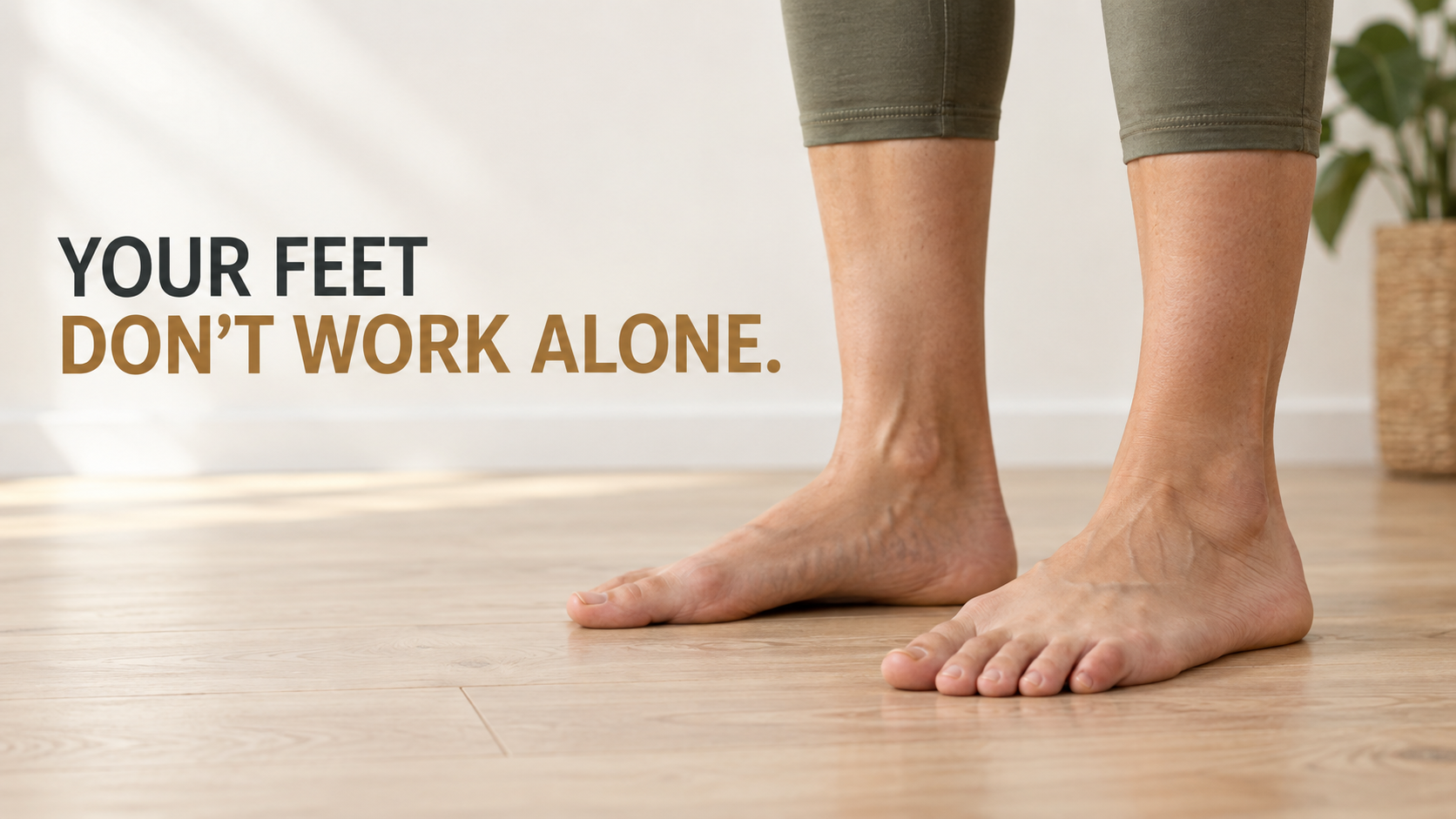
We tend to treat the feet as if they are two separate objects attached to the bottom of the body.
When they hurt, we roll them, stretch them, strengthen them, cushion them, or buy different shoes. Sometimes those things help. But when they do not create lasting change, it may be because we are looking at the foot alone.
Your feet are part of a two-way street between the ground and the rest of your body.
They sense the surface beneath you, receive your weight, adapt to pressure, and help transmit force back upward. At the same time, the position and movement of your hips and pelvis determine how that weight arrives at your feet.
The feet need the hips. The hips need the feet.
My Foot Wasn't Working Alone
I learned this through my own body.
For years, my pelvis and rib cage were caught in a rotational pattern. My body tried to create support by gripping through my lower back and neck. That twisting pattern also changed the way weight traveled through my legs and into my feet.
My big toe would not settle into the ground. I tried to manufacture stability by spreading and splaying my feet, but I still could not create a connected outer line through my leg and the little-toe side of my foot. My little toe began drifting outward, contributing to the shape of a tailor's bunion.
I kept working on the foot. I tried to spread my toes and lift my arch. But I could not create an arch that felt both strong and stable.
It felt like a disconnected circuit. The individual parts were there, but they were not communicating well within the larger pattern. The pathway I needed from my pelvis, through my hip and leg, and into my foot simply did not feel available.
Once I began reorganizing the twist through my pelvis and hip, something changed. I could finally speak to my feet. I could settle my big toe, connect through the outer edge, and give the arch shape without forcing or gripping it.
My foot became more stable because it was no longer trying to create stability by itself.
This does not mean that every bunion or foot problem begins in the pelvis. Foot structure, footwear, genetics, injury, activity, and many other factors matter. But it does mean that we cannot always understand the function of a foot by looking only at the foot.
The Feet and Hips Are a Two-Way Street
Every time you stand, walk, turn, or climb a step, information and force travel in both directions.
Your feet tell your nervous system how you are meeting the ground. Your hips and pelvis help position your legs and direct your weight into your feet.
If a foot cannot sense the ground or adapt to pressure, the hip may have less useful information to organize above it. If the pelvis cannot shift over one leg or the hip cannot rotate well, the foot may never receive the pressure it needs to respond naturally.
So instead of asking only, “What is this foot doing?” we should also ask:
What is arriving at the foot from above?
What information is the foot sending back up?
That is why isolated foot exercises sometimes help—and sometimes do not. You can become very good at spreading your toes while seated and still be unable to use your foot well when you stand, transfer weight, or walk.
A Responsive Foot Is More Useful Than a Perfect Foot
Functional foot training is not about holding a perfect tripod or lifting the arch as high as possible.
We want feet that can change shape in response to what the body is doing. They need to perceive the ground, receive weight, distribute pressure, and dynamically transmit force as we walk, balance, turn, climb, and push off.
Sometimes the foot needs to soften and yield. Sometimes it needs to become firm enough to support or propel you. Pressure must be able to travel through different parts of the foot at different moments.
A healthy foot is not frozen in one ideal position. It is responsive.
For beginners, I organize foot health around three simple ideas.
1. Feel the Ground
Before the foot can respond well, you need to know where your weight is going.
Can you feel your heel, the mound beneath your big toe, and the mound beneath your little toe? Does one foot feel clearer than the other? Is most of your weight falling inward, outward, forward, or backward?
This is not about forcing all three points down equally. It is about developing a clearer map of your contact with the floor.
Try this: Stand barefoot and slowly shift your weight forward, backward, and from side to side. Notice where pressure increases, where it disappears, and whether your toes grip to keep you from moving.
2. Let the Foot Move
The foot contains many joints because it is designed to adapt.
Your toes should be able to lift and lower. Your ankle should move over your foot. Your arch should be able to change shape as your weight shifts rather than remaining rigid or collapsing without control.
Spreading the toes can be useful, but width alone is not organization. The goal is not to splay the foot as far as possible. The goal is for the toes, arch, and ankle to participate together without unnecessary gripping.
Try this: Keeping your heel down, slowly allow one knee to move forward over the foot. Feel what happens through your ankle and arch. Can the foot adapt while the big-toe and little-toe sides remain available?
3. Connect the Feet to the Hips
This is where isolated foot work becomes functional.
Can your pelvis shift over one foot? Can your hip rotate while your foot continues to respond to the floor? Can you accept weight through one leg without collapsing, gripping your toes, or bracing somewhere else?
Foot strength matters, but we need to train it inside standing, balancing, walking, reaching, and changing direction. That is where the conversation between the feet and hips becomes usable.
Try this: Shift your pelvis slowly over one foot without leaning your entire torso. Notice how the pressure beneath that foot changes. Then return to center and compare sides. You may discover that what feels like a foot problem is partly a weight-shifting problem.
Feel It. Move It. Connect It.
These are the non-negotiables I return to again and again:
Can you feel the ground?
Can your foot move and adapt?
Can you connect the foot to the hip and pelvis during real movement?
We do not need feet that hold one perfect shape. We need feet that can sense, adapt, manage force, and respond to the rest of the body.
Sometimes the foot does need more local strength or mobility. Sometimes it needs a clearer pathway from above. Often, it needs both.
Healthier feet emerge from a better conversation between the ground, the feet, the legs, the hips, and the pelvis.
Explore It in Your Own Body
On September 24 at Sol Vibration, I am teaching a 60-minute foot workshop where we will explore my favorite drills and the non-negotiables for healthier feet.
We will work with foot mobility, strength, balance, and sensory awareness to help you feel more connected to the ground and supported through your whole body. Expect simple, practical exercises using movement, pressure, and props that you can continue using at home. All levels are welcome.
To preregister, visit Sol Vibration's homepage, scroll down to September 24, and select the Foot Workshop.