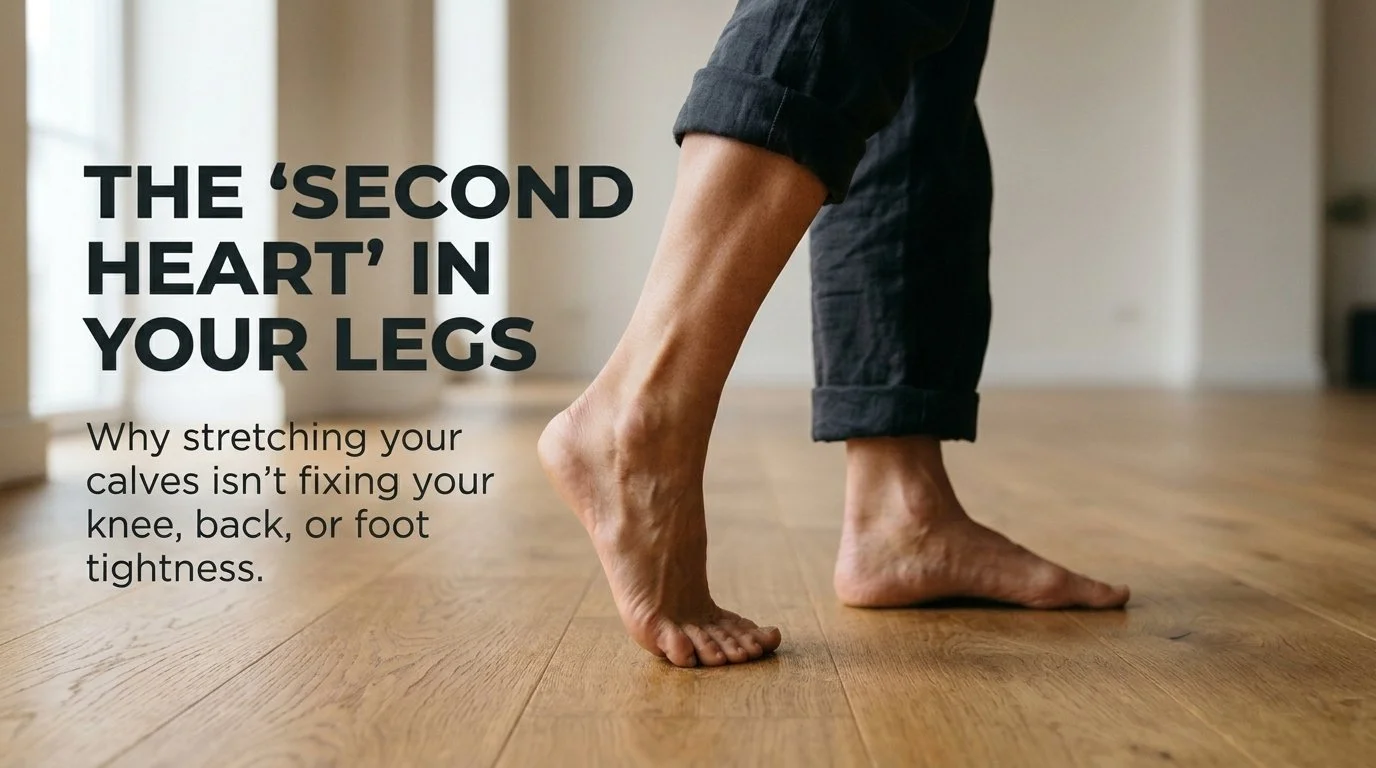
If you spend half your movement routine foam rolling your calves, holding long downward dogs, or stretching against a wall—only to find that your lower legs are tight again two hours later—you are not alone.
Most traditional calf-stretching protocols address the surface symptoms while completely overlooking the underlying mechanical conversation between your feet and a deeply buried powerhouse: the soleus muscle.
In biomechanics and somatic practices, the soleus is often referred to as the body's “Second Heart.” Nestled beneath the two prominent bellies of the gastrocnemius, this muscle houses a vast network of deep venous sinuses. Every time it contracts and relaxes rhythmically, it acts as a mechanical pump, driving pooling blood and stagnant lymph fluid back up your legs against gravity.
When your soleus is functioning cleanly, your legs feel light, responsive, and springy. When it’s compromised, you experience persistent lower-leg heaviness, poor circulation, and chronic calf tension.
Your Body's Built-In Shock Absorber
Beyond its circulatory duties, the soleus is your lower body's primary shock dampener. Every time your foot strikes the ground—whether you are walking, running, or landing a jump—the soleus contracts eccentrically to absorb that initial impact force.
When your foot mechanics are working smoothly, the soleus dissipates energy effortlessly. But when your midfoot or toes are locked, that unbuffered shockwave bypasses the foot and shoots straight up your kinetic chain—putting harsh, unbuffered stress directly into your shin bones, knees, hips, and lower back.
By restoring proper foot-to-soleus mechanics, you allow this deep muscle to protect your upper joints from daily wear and tear.
A Unique Blood Sugar "Sponge"
What makes the soleus even more fascinating is its remarkable metabolic machinery. Composed almost entirely of slow-twitch, oxidative muscle fibers, the soleus can burn local blood glucose and triglycerides for hours without relying on glycogen or causing fatigue.
When activated properly, it acts like a metabolic sponge, pulling glucose directly out of your bloodstream to regulate post-meal blood sugar levels. But to tap into this metabolic superpower, the neural connection between your arches, toes, and soleus must be fully online.
How Your Feet Sabotage Your Second Heart
Your feet are your body's primary interface with the earth. They are meant to be dynamic, adaptable structures that absorb impact, communicate with your nervous system, and create a solid lever for propulsion.
When foot mechanics break down, the soleus pays the price. Here are three common foot dysfunctions that shut down this essential muscle:
The Rigid Midfoot: If your foot cannot adapt to uneven surfaces or pronate smoothly to absorb shock, every step sends a jarring wave straight up your leg. The soleus loses its natural elastic "loading" phase and takes a brutal, repetitive pounding.
The Collapsed Arch: Conversely, if your foot collapses completely and stays stuck there, the soleus is trapped in a chronically over-stretched posture. It spends immense amounts of energy just trying to hold your shin bone stable, leaving it exhausted before your day even really starts.
The Stiff Big Toe: In order to propel your body forward efficiently, your big toe must extend comfortably. If your big toe is stiff or blocked, your arch cannot lock into a supportive lever. The soleus is forced to drag a heavy, unsupportive foot through space.
Stretching vs. Neuromuscular Repatterning
Passive stretching simply pulls on tissue that is likely tightening up to protect you from instability. To fix tight lower legs for good, you don't need another stretch—you need neuromuscular repatterning.
You have to teach your nervous system how to activate the deep intrinsics of your foot in tandem with the soleus. When your foot and soleus learn to handle load together again, the brain no longer feels the need to hold baseline protective tension in your calves.
Experience the Transformation Live
Uncovering whether your foot function is keeping your soleus tired and lazy requires hands-on exploration. You have to feel the difference between an uncoordinated heel raise and a fully integrated, grounded contraction.
On Thursday October 29 at 6:30pm, I am hosting an immersive, hands-on workshop: Wake Up Your Second Heart: Restoring Foot Function & Grounding at Sol Vibration in Sea Cliff, NY.
In this 60-minute live masterclass, you will learn:
Live self-testing to audit your own foot mechanics and joint mobility.
How to identify which of the 3 major foot saboteurs is affecting your kinetic chain.
Smart exercise modifications: How to scale every drill if you deal with flat feet, bunions, or rigid big toes, so you can train safely without joint pain.
The "Soleus Pushup" protocol: The exact seated movement mechanics to activate this metabolic blood sugar sponge without inducing fatigue.
Targeted repatterning drills to instantly reactivate your arch-to-soleus shock absorption system.
A daily 5-minute grounding flow to keep your knees, back, and lower body feeling light, powerful, and protected.
Spaces are limited to keep the group setting intimate and interactive.