The Problem Isn’t Always Where You Feel It
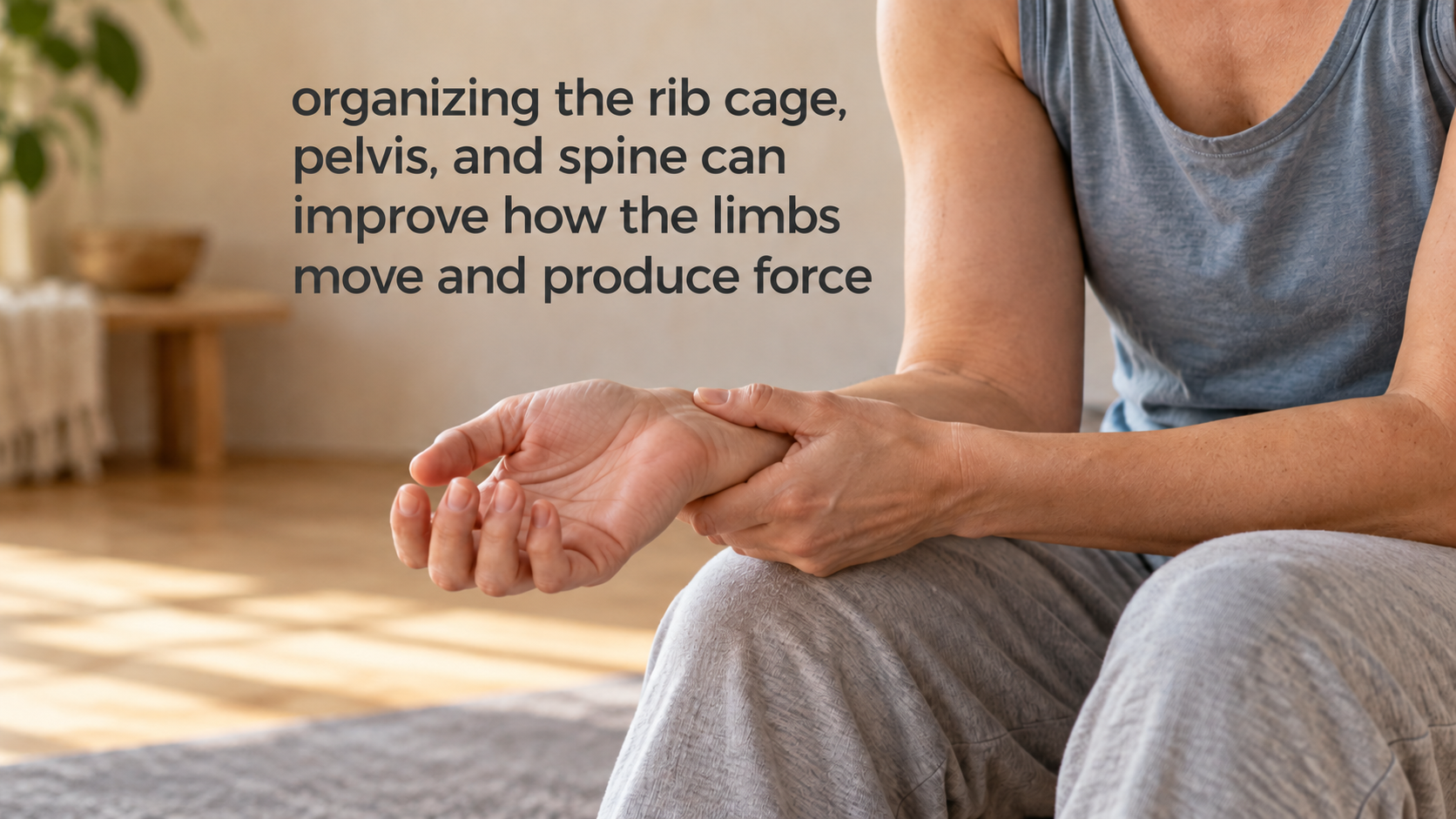
Why organizing the rib cage, pelvis, and spine can improve how the limbs move and produce force
When a client’s wrists hurt during a plank or fatigue quickly while holding weights, the obvious assumption is that the wrists are weak.
When someone’s knee bothers them during a squat, attention immediately goes to the knee.
When the neck and shoulders constantly feel tight, the usual response is to stretch the neck and massage the shoulders.
Sometimes the uncomfortable area really does need direct attention. But the place where you feel pain, weakness, or tension is not necessarily the only place contributing to it.
The body does not produce movement one joint at a time. Every push, pull, step, squat, and reach requires force to travel through a connected system. When one part of that system cannot manage or transfer force effectively, another part may have to absorb more pressure, create extra tension, or work harder to keep everything together.
That is why I often begin by looking at the body’s larger central structures: the rib cage, pelvis, and spine.
The trunk is more than your “core”
The trunk is the central platform from which the arms and legs move. The rib cage supports the shoulder blades. The pelvis provides the foundation for the hips. The spine connects these structures while allowing us to bend, rotate, breathe, stabilize, and respond to gravity.
These structures do not need to be held in one rigid or “perfect” posture. They do, however, need to work together.
When the rib cage, pelvis, and spine are poorly integrated, the limbs may be asked to create stability that should be shared by the rest of the body. That can show up as gripping, joint compression, shaking, collapsing, bracing, or a feeling that a particular area is simply weak.
Organizing the trunk can offer a significant return because it changes the platform for several other areas at once.
When “weak wrists” aren’t just about the wrists
One of my clients is young, fit, and strong in many ways, yet his grip fatigues quickly when he holds weights. Other clients have difficulty tolerating weight through their wrists or feel discomfort in a particular area of the palm during hands-and-knees exercises.
These experiences may all be described as wrist or hand weakness, but they can represent different limitations:
Low grip or forearm strength
Limited tolerance for bearing weight through the hands
Difficulty distributing pressure across the palm
Pain or sensitivity in one specific area of the hand
Limited wrist mobility
Poor coordination among the hand, wrist, elbow, shoulder, and trunk
Barring an injury or medical condition involving the hand, wrist, or elbow, it is worth looking farther up the chain.
The shoulder blade rests on the rib cage, making the rib cage part of the foundation for the arm. If the trunk cannot provide adequate support, the shoulder is poorly positioned, or the shoulder blade cannot organize effectively against the rib cage, the muscles of the hand and forearm may have to work harder to grip or bear weight.
Changing the organization of the rib cage, shoulder blade, and upper arm may improve how force travels into the hand. That does not mean the wrist, hand, or forearm never needs direct strengthening. It means we have created better conditions in which to strengthen it.
The knee lives between the hip and the foot
The same reasoning applies to the knees.
The knee sits between two highly influential regions: the hip and the foot. Its function is affected by how the pelvis organizes over the legs, how the hip controls the thigh, how the foot interacts with the ground, and how the ankle moves.
A foot that repeatedly collapses may alter how force travels through the lower leg and knee. But the foot does not exist in isolation either. Its behavior may be intertwined with limited hip control, pelvic imbalance, or difficulty organizing the leg beneath the body.
This relationship works in both directions.
That is why repeatedly strengthening the knee or stretching the area around it may not resolve the entire problem. We also need to ask:
Can the pelvis remain organized as weight shifts onto one leg?
Can the hip control the position and rotation of the thigh?
Can the foot accept and distribute pressure?
Can the ankle move without the arch collapsing or the knee twisting?
Can the entire leg share the force of the movement?
This does not mean that every knee problem is caused by a “crooked” pelvis or flat feet. Local injury, joint structure, training load, strength, mobility, and tissue tolerance all matter. But if the hip, knee, ankle, and foot are not working together, the knee may become the place where that disconnect is felt.
Neck and shoulder tension may involve the rib cage
The neck and shoulders are another common pain point.
The shoulder blades move across the rib cage, and the neck emerges from the upper spine. How the rib cage is positioned—and how well it moves during breathing—affects the foundation beneath both areas.
If the rib cage is compressed, lifted, flared, or unable to expand well, the muscles around the neck and shoulders may take on extra work. They may help hold up the head, stabilize the shoulder blades, move the arms, or even assist with breathing.
The result can be persistent neck tension, elevated shoulders, headaches, restricted shoulder movement, or the feeling that the upper traps are always “on.”
Stretching and massage may provide welcome relief. But if the rib cage, breathing mechanics, head position, and trunk support remain unchanged, the tension may continue returning because the conditions creating it have not changed.
Again, this does not mean that every neck or shoulder problem comes from the rib cage. It means the rib cage is part of the system and deserves to be assessed.
Proximal stability before distal mobility
In movement education, we sometimes use the phrase “proximal stability before distal mobility.” In plain language, it means that the hands, feet, arms, and legs often work better when they have an organized center to move from.
Stability does not mean rigidity. It does not mean sucking in the stomach, flattening the spine, or freezing the rib cage and pelvis in place.
Useful stability is adaptable. It allows the body to breathe, transfer force, respond to load, and move without requiring one small area to do all the work.
Before asking the hands and feet to work harder, it is worth looking at what they are connected to.
Treat the local area, but assess the system it belongs to
The painful or weak area should not be ignored. Wrist strength, foot function, ankle mobility, hip control, and shoulder capacity may all require direct work.
But focusing exclusively on the symptom can cause us to miss the larger movement pattern that keeps recreating the problem.
This is why 3C Movement begins with organization:
Find your stack. Breathe wide. Move from center.
When the rib cage, pelvis, and spine work together more effectively, the shoulders and hips gain a better foundation. The limbs have a clearer pathway through which to transfer force. Areas that have been gripping or compensating may no longer need to work quite so hard.
The problem is not always where you feel it.
Sometimes the place that hurts is the injured area. Sometimes it is locally weak or underprepared. And sometimes it is simply the place working hardest to manage a problem that involves the entire chain.
The goal is not to chase symptoms or impose perfect alignment. It is to understand how the parts influence one another—and create better conditions for strength, control, and confident movement throughout the whole body.