What Do My Jaw and Pelvic Floor Have to Do With Each Other?
For years, my jaw was tight, my feet were sore and cramping, my arch was collapsed, and my pelvic floor held too much tension.
Then there was my breathing. Until recently, I often felt like I couldn't quite finish a breath. I could inhale, but it didn't feel complete. I could exhale, but something still felt held.
It was a lot of holding on for one body.
As a movement teacher, I find this fascinating. As the person living in that body, I would also appreciate a little less fascination and a little more comfort.
What has helped me is learning to look beyond each individual area. Not just asking how to relax my jaw or strengthen my feet, but understanding the relationships between them.
Because the place where something bothers you is not always the only place worth investigating.
Following the Connections
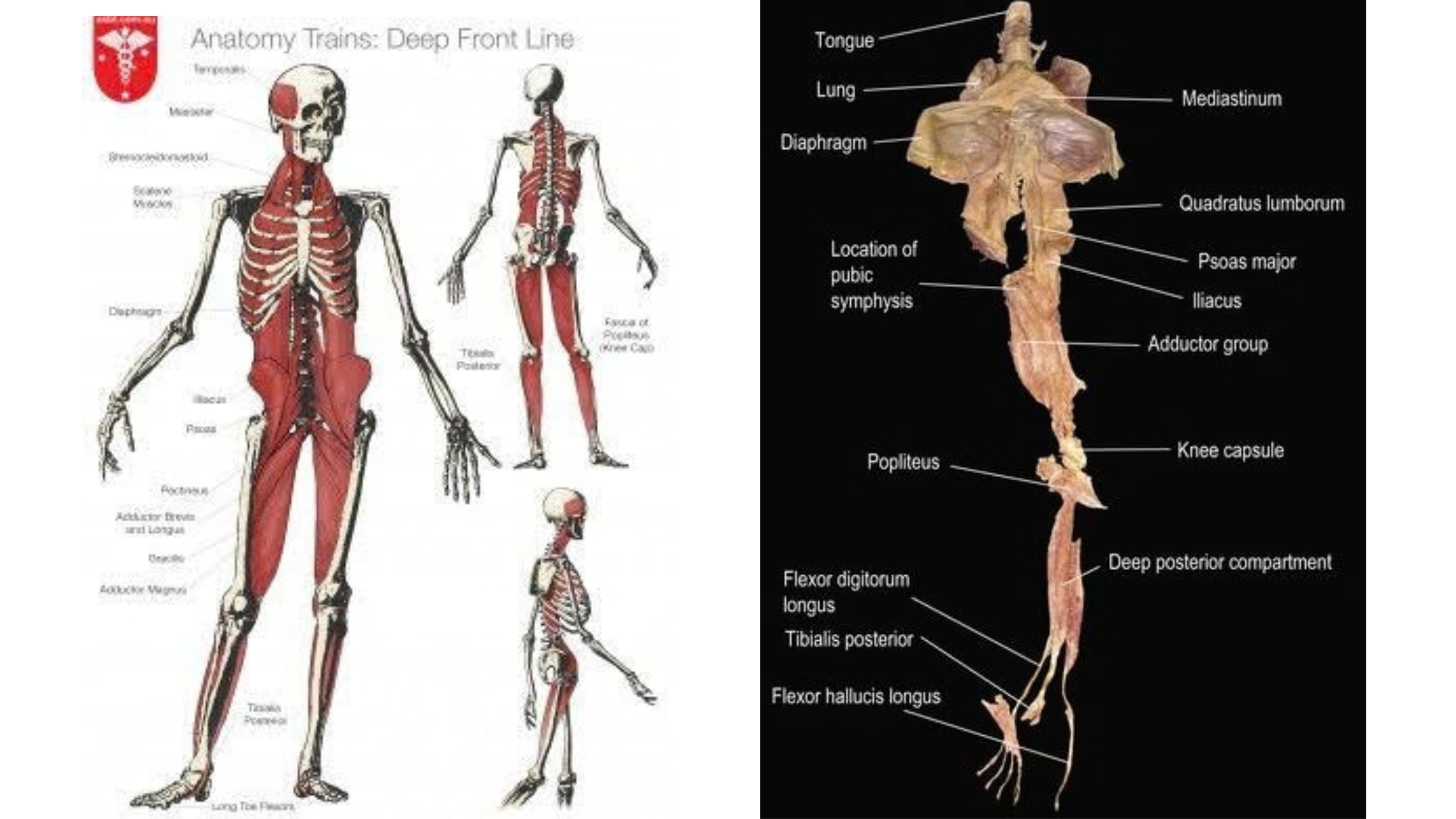
One framework that has informed my thinking is Anatomy Trains, developed by Thomas Myers. It maps relationships between muscles and fascia—the connective tissue that surrounds and links structures throughout the body.
Its Deep Front Line is especially interesting to me. This myofascial map starts deep in the feet, travels through the deep lower legs and inner thighs, includes pathways through the pelvis and pelvic floor, and continues through the psoas and diaphragm into the deep neck, throat, and mouth.
Feet. Pelvic floor. Breathing. The region around the jaw.
Suddenly, the list of things I had been dealing with became a much more interesting conversation.
The Deep Front Line gives me an anatomical map for exploring that conversation. The nervous system adds another layer: it coordinates how we use our muscles, and fascia itself contains sensory nerve endings. These regions have different nerve supplies, but they participate in the same body's movement and support strategies.
I want to understand both the connections and what I am doing with them.
Support Without Holding Everything Tight
Take breathing. The diaphragm and pelvic floor move in coordination: during inhalation, both can descend; during exhalation, both can rise. That parallel movement has been observed with dynamic MRI.
There is movement built into this system of support.
That matters to someone who has spent years feeling held in her jaw, pelvis, feet, and breath. My goal isn't simply to make everything stronger. I want support that allows me to move—and allows me to stop working so hard when that effort is no longer needed.
I bring that attention into my foot work, too. When I try to create an arch, am I gripping my toes? When I concentrate on what my legs are doing, am I clenching my jaw? Am I finding support, or am I adding tension everywhere I know how?
Those questions are much more useful to me than telling each body part to behave itself.
Even research is beginning to explore these less obvious relationships. One small study found reduced resting pelvic floor activity after soft-tissue treatment around the jaw in women with jaw-region pain. The researchers are still investigating the mechanism, but the finding is a good example of why looking beyond one area is worthwhile.
This Is Why I Care About Anatomy
Recently, during a period of intensive movement work and changes in longstanding neck and shoulder tension, I experienced another episode of pelvic discomfort, urinary urgency, and a feeling of bladder fullness.
It brought my attention back to how much I was doing and where I was holding tension. I was also rehabilitating my feet. There was a lot happening in my movement practice, and looking at my pelvis alone would have left out that context.
This is the value of understanding the relationships. It gives me somewhere to look beyond the symptom. It helps me examine how I am distributing effort and what changes when I organize differently.
And it shapes how I teach.
We don't have to memorize every muscle or become obsessed with monitoring ourselves. But we can learn enough about our bodies to ask better questions.
We can notice that working on one movement comes with a clenched jaw. That trying to find stability comes with a held breath. That our idea of “engaging” involves gripping much more than the task requires.
Then we can explore another way.
For me, anatomy becomes meaningful when I can connect it to something I feel. A map on a page becomes a landmark in my own body. Something I can recognize, explore, and use.
That's what I want to share: not just that the body is connected, but that understanding those connections gives us more choices.