Are You Truly Mobile—or Just Moving Around the Stiffness?
You stretch your hips regularly. You can get into pigeon pose. Maybe you can even fold yourself into an impressive-looking 90/90 position.
But your lower back is still tight.
Your shoulders still creep toward your ears.
And somehow, your hips never feel genuinely free.
So what’s going on?
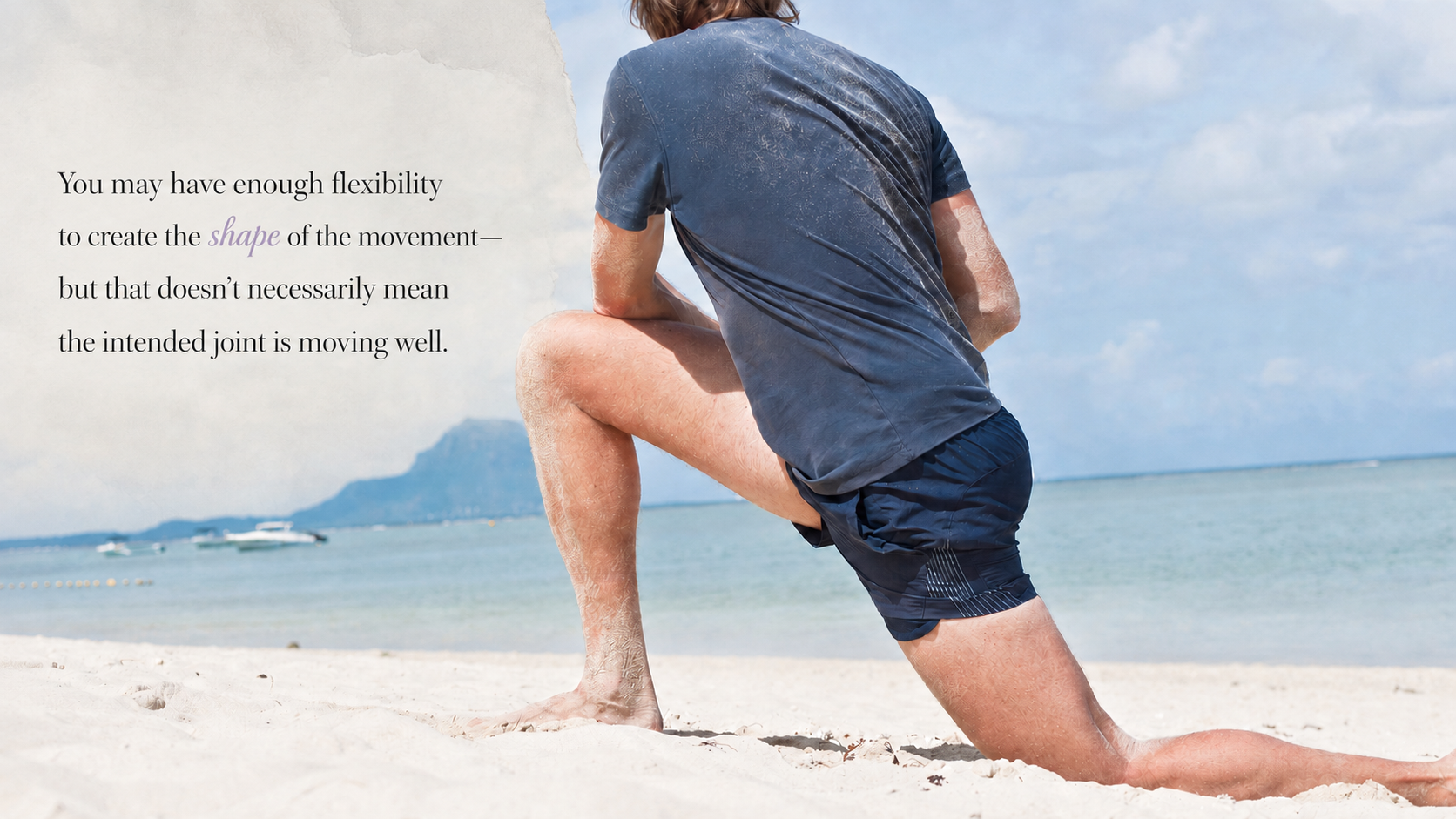
You may have enough flexibility to create the shape of the movement—but that doesn’t necessarily mean the intended joint is moving well.
Your body may simply be borrowing that movement from somewhere else.
Your body will always find a way
Your brain has one primary objective when you ask your body to perform a movement: complete the task.
It doesn’t necessarily care where the movement comes from.
If your hip doesn’t rotate easily, your pelvis may roll.
If your shoulder doesn’t move freely overhead, your ribs may flare and your lower back may arch.
If your upper back doesn’t rotate well, your pelvis or neck may turn farther to create the appearance of more range.
You still reach the position. You may even feel a strong stretch. From the outside, the movement can look successful.
But the joint you intended to mobilize may not be doing very much at all.
This is an example of relative flexibility: movement follows the path of least resistance. The more mobile parts of your body contribute extra movement to compensate for the areas that are less mobile, less organized, or harder for you to control.
Flexibility gets you into the shape. Mobility tells you how you got there.
Flexibility generally describes how far your tissues and body can move into a position.
Mobility includes something more: your ability to access and control movement at a particular joint.
Imagine letting one knee fall out to the side while lying on your back.
If your entire pelvis rolls with the leg, you can create a large movement. But much of that range may be coming from your pelvis and lower back.
Now keep both sides of your pelvis heavy and let only the thigh rotate inside the hip socket.
Suddenly, the movement may become much smaller.
That smaller movement isn’t worse. It may be the first time you’re seeing—and feeling—what your hip can actually do without borrowing range from its neighbors.
Common places we borrow movement
Relative flexibility can appear throughout the body:
Your leg travels behind you, but your lower back arches instead of your hip extending.
Your arms reach overhead, but your ribs flare and your neck tightens.
You touch your toes, but most of the movement comes from rounding your spine rather than hinging through your hips.
Your knee reaches forward in an ankle mobility test, but your arch collapses and your foot turns out.
You perform a deep squat, but your feet collapse, your knees rotate inward, and your pelvis tucks underneath you.
You turn your head, but your shoulder and rib cage rotate along with it.
None of these movements are inherently wrong. Your spine, pelvis, ribs, feet, and shoulder blades are supposed to move.
The question is whether you have choices—or whether your body relies on the same compensation every time.
Compensation isn’t failure
A compensation is your brain’s solution to a movement problem.
Your body is remarkably resourceful. If one area doesn’t provide enough mobility or stability, another area steps in to help you complete the task.
That strategy may have developed because of an old injury, repetitive posture, pain, stress, training habits, or simply years of moving in the same way.
At first, the compensation may be useful. But when your body depends on it repeatedly, certain muscles and joints can begin doing more than their fair share.
That may be why you keep stretching, rolling, massaging, or adjusting the same tight areas—only for the tension to return.
The tight area may not simply need to be loosened. It may be working overtime to create movement or stability that your body isn’t finding elsewhere.
True mobility needs a stable reference point
For one part of your body to move clearly, another part needs to provide enough support.
Your thigh bone can’t move distinctly inside the hip socket if your pelvis and lower back travel everywhere with it.
Your arm can’t move clearly relative to your rib cage if the ribs immediately flare and the neck braces.
This doesn’t mean holding your body rigidly or forcing yourself into “perfect posture.” Your body is designed to move as an integrated system.
But sometimes we temporarily reduce movement in one area so you can finally sense and develop movement in another.
First, you learn to recognize the compensation.
Then you find the movement you were missing.
Finally, you integrate that new option back into walking, squatting, reaching, lifting, running, and everyday life.
The goal isn’t to move like a collection of isolated parts. It’s to give the whole body more choices.
You can’t change a compensation you can’t feel
Most compensations happen automatically.
You probably don’t consciously decide to flare your ribs, elevate your shoulders, collapse your foot, or twist your pelvis. Your brain has practiced the strategy so many times that it now feels normal.
This is why awareness is not an optional extra. It is the beginning of meaningful change.
You may think you’re just tight, stiff, or misaligned.
But what you’re feeling may be the result of a compensation your brain has practiced until it became automatic.
The good news?
Automatic doesn’t mean permanent.
Through the 3C Movement Method—Concentrate, Connect, Control—you can wake up to these patterns, reorganize how your body works together, and learn to control your movement for yourself.
Concentrate to sense what is actually happening.
Connect the parts of your body that need to work together.
Control the movement with greater precision before adding more range, speed, or load.
You don’t need to stretch harder or force your body into a more impressive shape.
You need to understand where the movement is coming from—and teach your body another way.
Sometimes the smaller movement is the more honest one.
And that honest movement is where real change begins.