Why Pressure Helps You Organize Your Body
Have you ever noticed that a movement suddenly feels clearer when you press into something?
Maybe you squeeze a Pilates ball between your hands and your trunk feels more connected. Maybe pressing your foot into the floor helps you feel your hip. Maybe pushing your hand into a wall makes your shoulder blade and rib cage seem to organize themselves more naturally.
That is not your imagination.
Pressure gives your nervous system more information.
Your brain is constantly trying to answer questions like:
Where am I in space?
Which joints are moving?
How much force am I producing?
What needs to stabilize so another part of me can move?
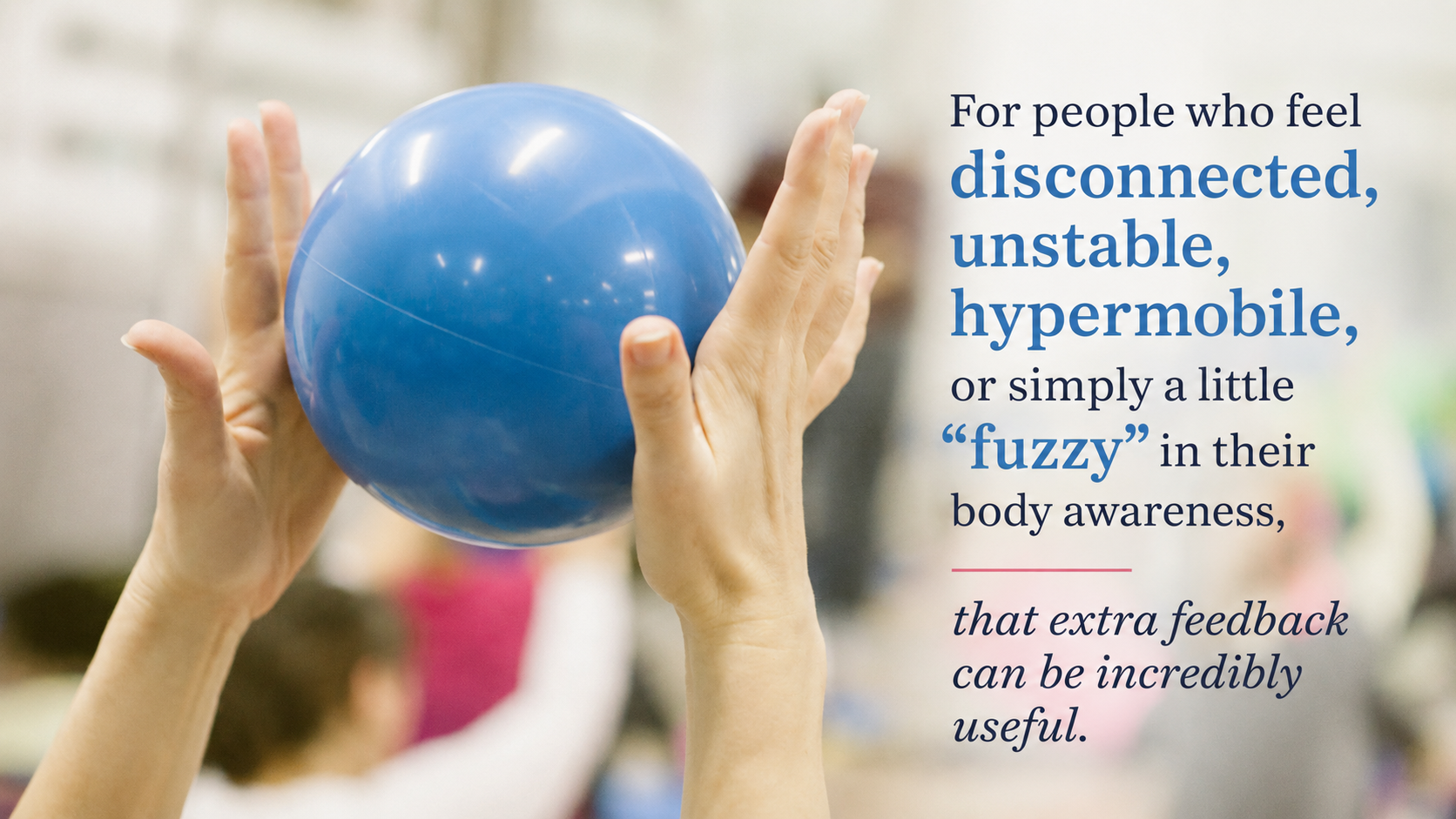
When your sensory map is clear, those questions are easier for your nervous system to answer. When that map is fuzzy, movement can feel disconnected, unstable, or strangely difficult to control.
Adding pressure can turn up the volume on that sensory information.
Pressure Gives Your Brain Something Concrete to Respond To
Think about holding your arms in front of you with nothing in your hands.
There are many possible ways your shoulders, ribs, spine, and pelvis can organize themselves to maintain that position.
Now place a small Pilates ball between your palms and press into it gently.
Suddenly, there is a task.
You are no longer simply holding your arms in space. You are producing force against an external object.
Your nervous system has more information coming from the skin, muscles, tendons, and joints. It also has to figure out how to manage the force you are creating.
That can make the relationship between your arms and your trunk easier to perceive.
The same thing happens when you press your foot into the floor.
The floor pushes back.
Your body has to organize the ankle, knee, hip, pelvis, spine, and trunk to receive and transfer that force.
Or when you press your hand into a wall, you may suddenly become aware of a connection that feels something like:
hand → arm → shoulder blade → rib cage → trunk → pelvis → feet
The pressure did not magically “activate your core.”
It simply gave your nervous system a clearer problem to solve.
Your Center Is Where Force Gets Organized
I often think of the center of the body less as something you squeeze and more as the place where force gets transferred.
Your arms and legs do not operate independently from the rest of you.
If your right arm pushes, your trunk has to respond.
If your left foot presses into the ground, the rest of your body has to manage that force.
This is why pressing opposing limbs into something can be so revealing.
For example, lie on your back with your knees bent over your hips. Place a yoga block between your right hand and left thigh and gently press them toward one another.
Then slowly move the opposite arm or leg.
That little bit of pressure often makes the center of the body much easier to feel.
You have essentially given your nervous system an anchor.
Now the trunk has to organize itself between the forces coming from the limbs.
This Can Be Especially Helpful for Hypermobile People
If you are hypermobile, you may already have plenty of movement available to you.
The challenge may not be creating more range. It may be developing better control within the range you already have.
Hypermobile joints can sometimes provide less obvious sensory information about where they are in space, particularly when someone tends to rest at the end of their available range (locking your knees in hyperextension when standing for example).
External pressure can create a stronger reference.
Pressing gently into a ball, wall, floor, or Pilates ring can make it easier to feel where your limbs are, how they relate to your trunk, and how much muscular support you are creating around a joint.
In other words:
If your body has a lot of movement options, pressure can sometimes help your brain narrow those options and find a more stable strategy.
If Your Body Awareness Feels Fuzzy, Pressure Can Help
There are also times when movement simply feels disorienting.
Some examples: You know where your arm is intellectually, but you do not quite feel connected to it, one side of your pelvis feels vague, your foot seems disconnected from your hip, or your shoulder blade feels like something you can describe anatomically but cannot actually control.
In those moments, an external reference can be extremely useful.
A wall, the floor, a small weight, or a ball pressing back into your hand all give you information your nervous system can ORGANIZE AROUND.
When your brain body map feels fuzzy, external pressure can sometimes make connections easier to find.
Harder Does NOT Equal Better
This is important. More effort does not necessarily create better organization.
The goal is not to crush the Pilates ball or squeeze the Magic Circle as hard as possible.
In fact, excessive pressure can make you revert to the exact compensations you are trying to move away from:
clenching the jaw
shrugging the shoulders
holding the breath
flaring the ribs
gripping the superficial abdominal muscles
locking the joints
The sweet spot is usually much gentler.
Think 20 to 30 percent effort.
Enough pressure that the sensory information becomes clearer, but not so much that your entire body starts bracing.
A cue I often use is: Press enough to ORGANIZE AROUND.
You should still be able to breathe and move with ease.
And ideally, the rest of the body becomes quieter rather than more rigid.
The Prop Is a Clue, Not a Cure
This is also where I want to be very careful.
Using a prop can create a useful moment of clarity.
It does not automatically mean you have changed the underlying movement pattern.
You can press into a ball and still subtly hike a shoulder.
You can push into the floor while rotating your pelvis.
You can squeeze a Pilates ring while gripping your neck.
You may even feel more stable while still organizing yourself around a compensation you do not yet perceive.
That is why better feedback is only the beginning.
Lasting change requires learning how to interpret what you feel.
At first, the process may simply be:
“I can feel something.”
Then:
“I can tell that my two sides feel different.”
Then:
“I can feel which part is moving and which part is compensating.”
Then:
“I can change it.”
And eventually:
“I can coordinate all of these areas while the whole body remains connected.”
That progression can take time.
Sometimes a lot of time.
There Are No Magic Exercises
I wish I could tell people that one exercise, one cue, or one prop will fix everything.
It will not.
I have had moments where pressing into something suddenly made part of my body clearer, and those moments mattered A LOT, but they were part of a long and winding road.
The deep transformation came from years of refining my sensory perception and subtle muscular control throughout my entire body.
Head.
Neck.
Shoulders.
Collarbones.
Rib cage.
Pelvis.
Legs.
Feet.
There were places I thought I was controlling that I was not.
There were areas I could barely feel, which meant I was not using them effectively.
There were compensations I remained inside for a long time simply because I did not yet understand what a better option felt like.
The only way I moved beyond them was through continual experimentation.
Feel.
Try something.
Observe.
Adjust.
Try again.
That process gradually created a more detailed internal map.
And as the map improved, so did my ability to make different movement choices.
The Goal Is Not Dependence on the Prop
Eventually, you want to be able to take the ball away.
Remove the yoga block.
Step away from the wall.
And keep some of the organization you discovered.
Your job is to learn it well enough that you can eventually find it yourself.
A breakthrough can happen in a moment.
Integration takes practice.
And that is the part of movement training that no trick, tool, or Instagram Reel can replace.
Better feedback can open the door.
But lasting change comes from returning to the work again and again — paying attention, experimenting, refining, and developing an increasingly sophisticated relationship with your own body.
The prop is a clue.
The practice is learning how to listen.