Control of the Leg Begins Behind the Heart
I was listening to Core Awareness by somatics educator and psoas expert Liz Koch this morning — the same book I referenced in my recent post, Say Hello to Your Psoas. There’s a chapter on properly engaging the psoas, and in the middle of it she says:
“Control of the leg begins behind the heart.”
It struck me as interesting so I paused the audio and tried it.
Exploring the New Cue
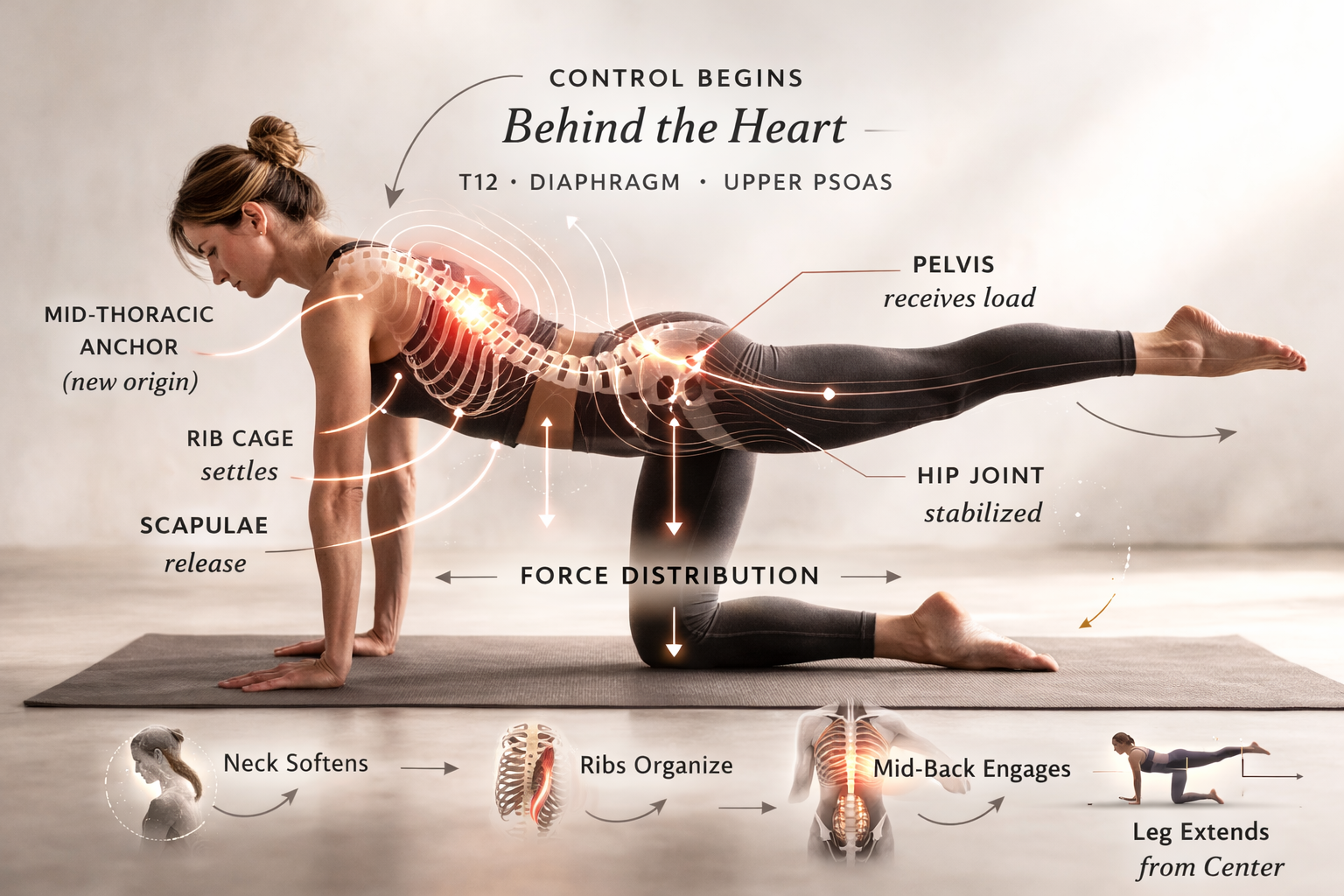
I went in to a hands and knees position and shifted my attention to the back of my rib cage — the space behind my heart, the mid-thoracic area (normally a “dark” area for me). Once I senses and organized from this new area creating an “anchor” there, I extended my right leg back to the height of my hip and tuned in to check how my body was organizing with this new strategy.
Almost immediately, the base of my neck softened. The shoulder tension I subtly rely on to stabilize dissipated. My scapulae dropped out of their habitual elevation. Something deeper in the mid-back had come online and was now acting as a stable integrated base to support the weight of my lifted leg.
Most people think leg control starts at the hip.
Strengthen the glutes, stretch the hip flexors, mobilize the capsule, etcetera…But if you’ve ever felt your leg go dead… or grip in to your lower back… or hike your hip no matter how many bridges you do — you already know that explanation is incomplete.
The leg is downstream.
Before the hip can extend, rotate, or stabilize, the trunk has to organize. And not just the pelvis.
Higher. Behind the heart.
An Important Intersection
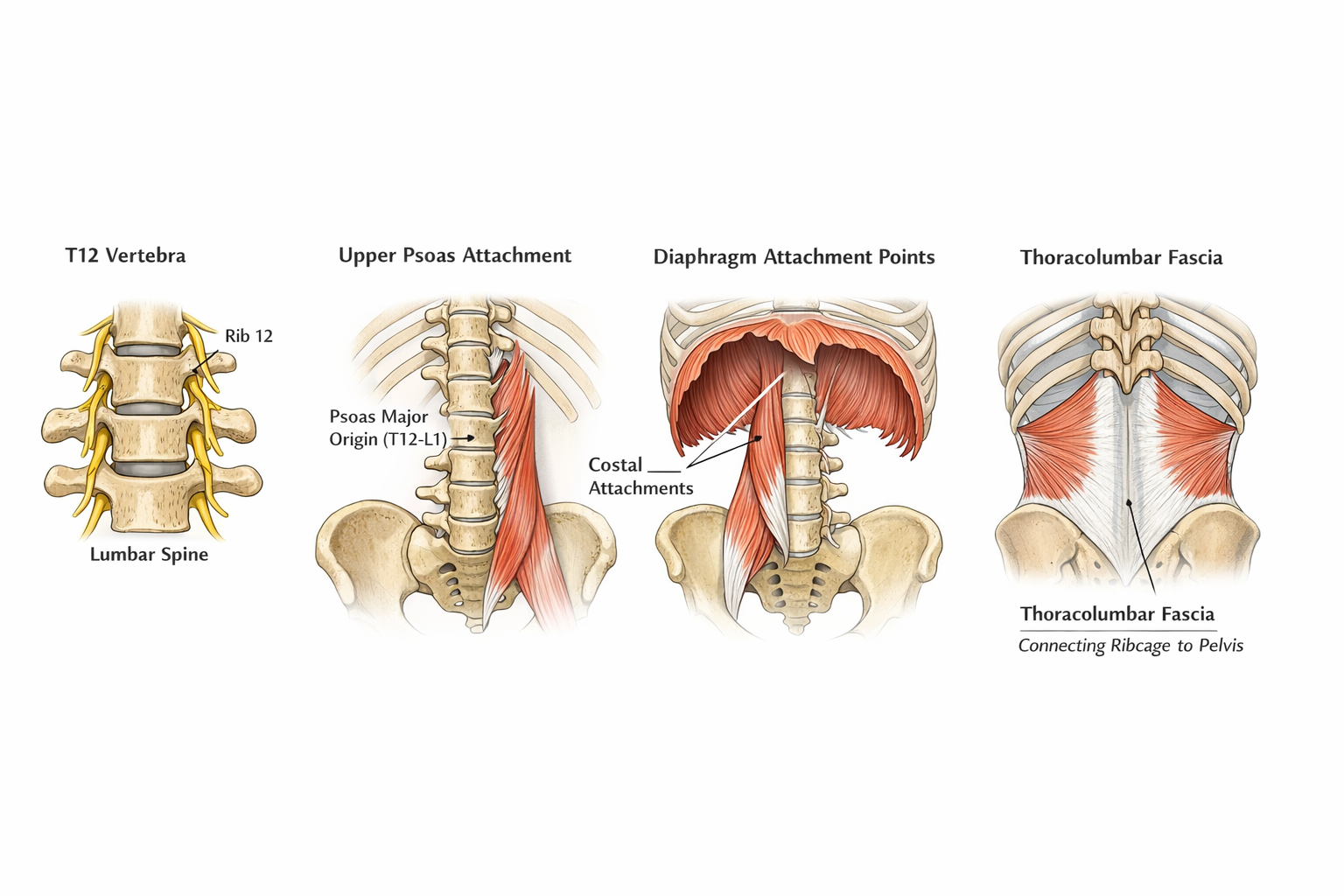
Behind the heart sits the mid-to-lower thoracic spine — especially the T12 region, where the diaphragm, upper psoas, and thoracolumbar fascia intersect.
This is a structural crossroads.
The diaphragm attaches along the lower ribs and lumbar spine.
The upper fibers of the psoas anchor near T12 and the lumbar vertebrae.
The ribs articulate and rotate here.
The deep spinal stabilizers create subtle, continuous support.
The thoracolumbar fascia links the rib cage to the pelvis, transmitting load between upper and lower body.
If this zone is disorganized, the pelvis has nothing steady to respond to. And if the pelvis is unstable, the leg has no honest origin.
An Important Intersection Behind the Heart
This area regulates pressure and distributes force . It determines whether load transfers cleanly into the hips — or collapses into compensation.
My body has Transformed through small cues like this.
My body didn’t transform out of pain and get stronger at 42 than its ever been because I found one magic exercise.
It changed because I kept following small cues like this and I practiced every day.
A shift in where I anchor from.
A clearer sense of where my femur actually sits.
A softer neck when the ribs organize.
A more honest base when the mid-back engages.
Over time, these small refinements began talking to each other and zones integrated.
Nothing about it was dramatic. It was iterative. Curious. Layered. And happened over time with consistent practice.
The signal improved. And when the signal improves, the body reorganizes itself.
This is the process I keep returning to in my work — SOM: sense first, then organize, then move.
Sometimes control begins lower than we think.
Sometimes it begins behind the heart. <3