You Can’t Control What You Can’t Feel
The soul of good movement is control.
Pilates used to be called Contrology by Joseph Pilates, after all — the art of complete coordination of the body, mind, and spirit.
Control is the aim.
But what precedes control — what almost no one talks about — is sensory awareness.
You cannot control what you cannot feel.
I found Pilates on my journey to being pain-free because I knew it was about control. I wanted rigor. I wanted precision. I wanted to understand anatomy and biomechanics deeply enough to apply them to my own body.
But I kept hitting the same wall.
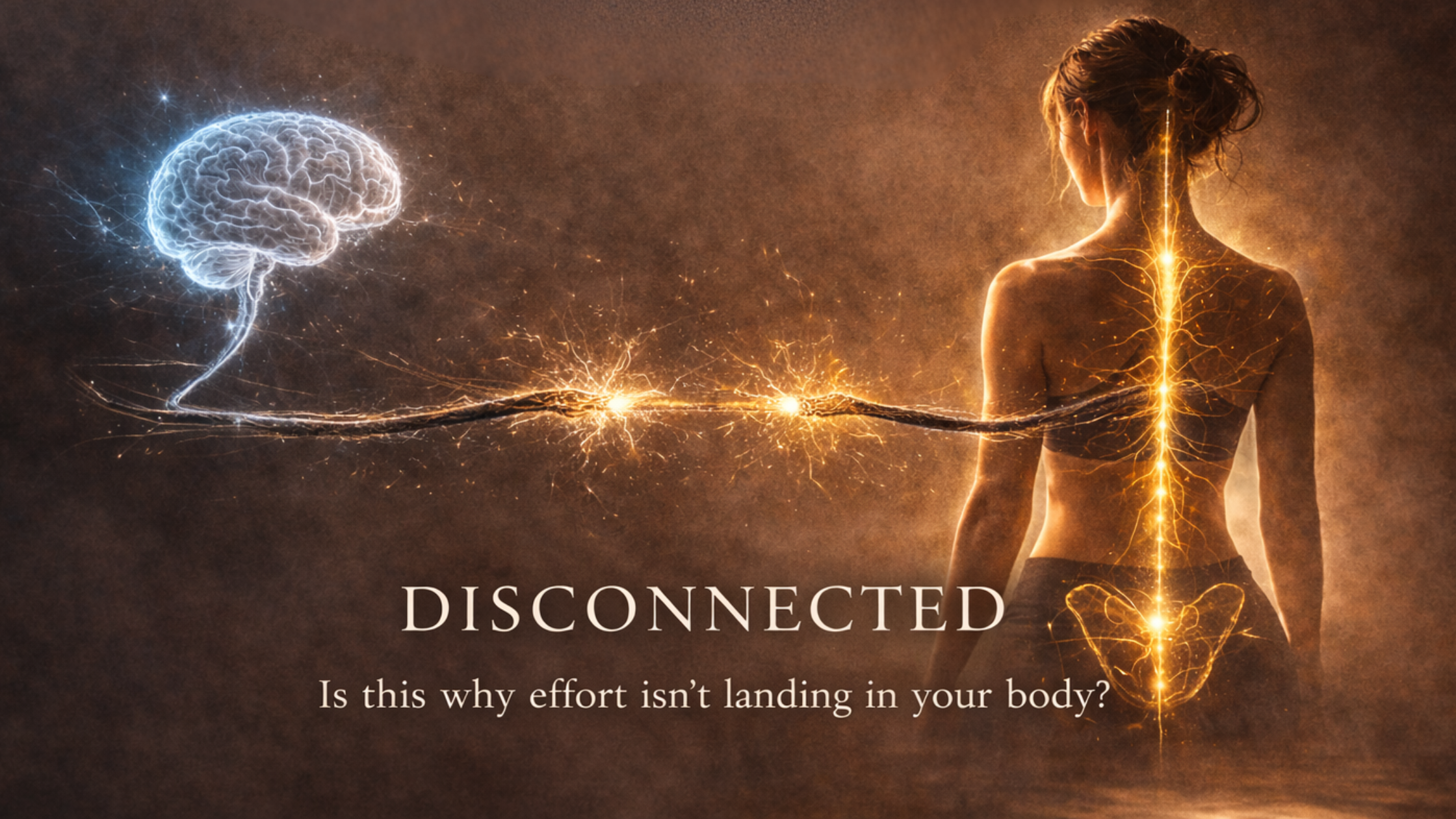
I could not FEEL.
Cues from the best instructors — including my own second-generation Classical Pilates master teacher — would not land in my body. I understood what I was supposed to do. I knew which muscles were meant to fire. I knew the theory.
But it was as if the signal from my brain just wasn’t received.
I felt frustrated. Embarrassed. Sometimes trapped in my own disobedient body.
I could execute the shapes. I could perform the choreography. But inside, I was guessing. Twisting. Squirming. Straining. Trying to figure it out night and day for five years.
I wasn’t numb. But I didn’t have clarity.
I wasn’t going to give up.
I had moments of discovery — flashes where something finally made sense. I became obsessed with understanding how movement was achieved. Not just copying it, but decoding it.
How do I have to THINK to improve the connection to my muscles?
My practice expanded beyond Pilates and strength training into exploration — movement in all planes, almost dance-like experiments and contortions. I set the bar higher and higher for how clearly I could connect, balance, isolate, and feel load transfer and rebound.
I endeavored for years and developed a daily practice and my own drills and techniques for improving my sensory motor awareness.
Gradually, my body began “unfolding” and organizing WITH me.
If you’re working hard but something still isn’t landing, start by identifying where your signal is unclear. Take the Body Quiz here.
I realized there is a language the body speaks that is beyond conscious will.
You cannot bully the body into submission; REAL control only emerges when perception is clear.
I began to understand that I had to go about it systematically — patiently — and that I needed reference points to hold on to for when I got overwhelmed or confused in my body.
I call them Sense Anchors.
A sense anchor is a physical reference that sharpens perception and gives the nervous system a reliable starting place.
Some examples:
A dumbbell resting across my lower abdomen so I could feel what my deep core was actually doing.
My hands placed on the sides of my ribs to gauge whether I was expanding evenly on inhale and organizing properly on exhale.
Returning sensation to my feet and hands — imagining them like a panther’s paws in contact with the earth.
Learning how to encourage my shoulder blades to anchor, not by yanking them down, but by organizing my ribcage and pelvis so the back body could participate.
The anchors were like familiar waypoints that helped me bridge to further integration.
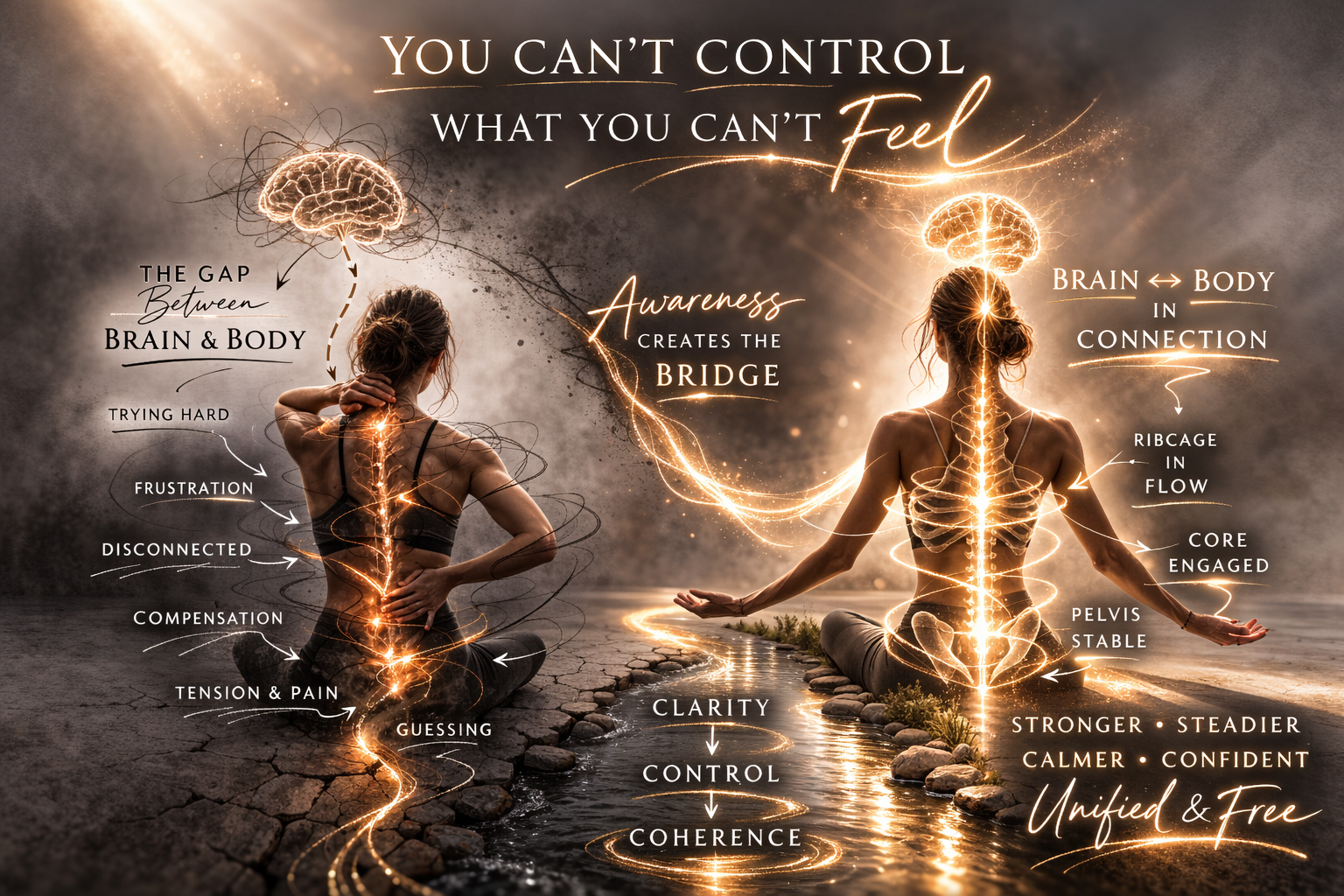
When clarity improved, control became possible.
For example, I recently learned how to position my shoulder blades so they truly anchor down and stop floating up to my ears causing chronic neck, jaw, and shoulder tension and affecting my available range of motion and movement quality.
But that anchoring only became available once I understood how to breathe and organize my ribs properly.
When my ribcage and pelvis are in conversation — when the back body shortens slightly and the system feels unified instead of segmented — my shoulder blade can settle into support.
That changed everything.
Weighted bicep curls became cleaner. Overhead pressing felt constructed instead of chaotic. My right shoulder stopped catching at end range. Hanging no longer felt compressive.
I finally learned how to use my back in an organized way.
At first, engaging my lower traps felt foreign — almost shocking. I had absorbed the idea that I shouldn’t “use my back” too much.
But when the trunk was organized, posterior support felt incredible.
Strong. Stable. Right.
When my body feels unified instead of segmented, I feel stronger, steadier, and calmer — almost blissful simply standing or sitting…just existing.
Finally my system isn’t fighting itself.
When signal is clear, the nervous system settles and THAT is the real gift of control.
If your core won’t “engage” no matter how hard you try…
If your shoulders grip despite perfect cues…
If you understand anatomy but still feel disconnected…
It may not be a strength problem.
It may be a signal problem.
Before you try harder — Turn the lights on.
You cannot control what you cannot feel.
And once you can feel clearly, control becomes something you refine, not something you fight.
Ready to find where your body is disconnected?
Take the Body Quiz.