Why Your Body Feels Worse in the Morning (And How to Fix It)
You’re making progress during the day—your movement is clearer, things feel more connected, maybe even lighter or more organized—then you wake up feeling stiff, twisted, tight, and sore. I experienced this often on my journey to regain body control, and I know how frustrating it is.
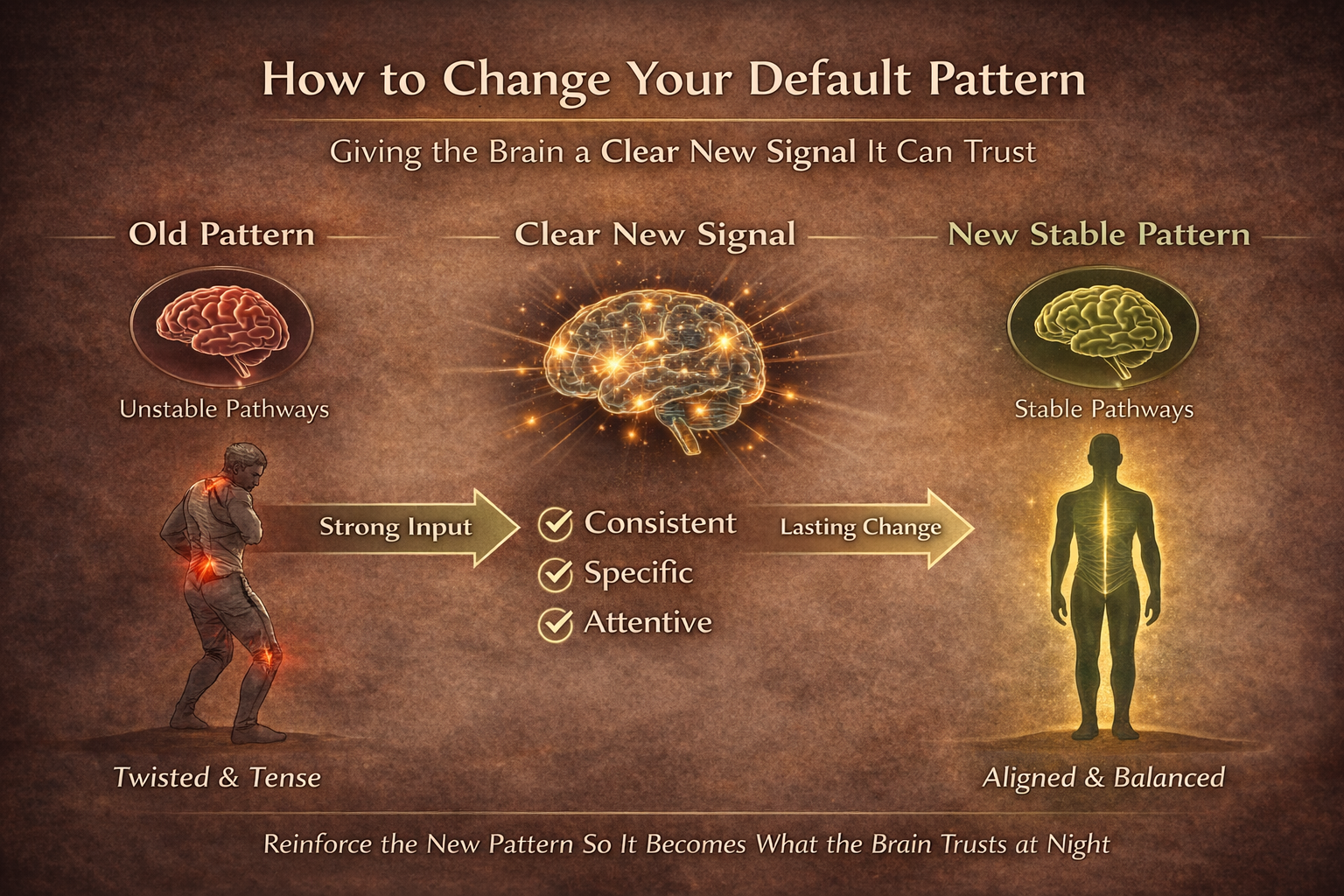
What’s happening isn’t that your body is undoing the work. It’s that it’s returning to its default pattern once conscious control goes offline.
And the good news is—it can change. If the new signal is clear enough.
Your Baseline
A default pattern is the way your system organizes itself when you’re not actively paying attention. It’s your baseline—how you hold tension, how things stack, what muscles grip, and which ones go dark.
It’s something your nervous system has been reinforcing for a long time.
From a neurological standpoint, the brain keeps the patterns it uses most. Repeated patterns become more efficient and more automatic—that’s basic neuroplasticity.
When you introduce something new during the day—a different way of organizing, a clearer connection, a better distribution of effort—it can feel obvious in the moment, but it hasn’t been reinforced enough yet to replace what’s already established.
Want to find out your default pattern? Take my 5-minute Body Quiz and get a guide sent to your inbox.
Sleep Stabilizes What You Practice
There’s strong evidence that motor patterns are consolidated during sleep, which means the pattern your system is most familiar with is the one it returns to.
If the new pattern isn’t stable yet, it fades into the background—not because it’s gone, but because it’s not the default.
How a New Default Is Established
That baseline only changes when the new pattern becomes more familiar than the old one.
Research on motor learning and habit formation shows that this happens through repeated, meaningful input over time—often weeks, not days—and only when the signal is clear enough for the brain to recognize and keep.
How Long Does It Take?
The nervous system changes based on what it experiences most often, most clearly, and with enough attention to register.
Occasional intense effort doesn’t override default patterns. Random, unfocused movement doesn’t either.
For actual change to occur, the input has to be:
consistent (daily or near-daily)
specific (you know exactly what you’re doing)
attentive (you’re actually present for it)
That’s why short, regular practice works better than infrequent, intense sessions. You’re not trying to exhaust the body—you’re giving the brain a clear alternative often enough that it starts to choose it on its own. Read more about how a low-friction daily practice can change your body more than any weekly exercise class.
Sense → Organize → Move
This is where my framework Sense → Organize → Move becomes useful.
You’re not just going through exercises—you’re increasing specificity and awareness by learning how to feel what’s happening, bring quieter areas online, reduce unnecessary tension, and then integrate the system as a whole. Read more about my SOM framework here.
That’s the kind of input that will eventually change the default pattern.
The Compounding Effect
Over time, repetition starts to compound.
You don’t lose it as easily. You don’t have to search as hard in the morning.
The body begins to carry more of that new organization through the night, because it’s no longer new—it’s becoming familiar.
And that’s really the goal.
Not trying to control your body while you sleep, but changing what it recognizes as normal.
Working with a guide in real time can shorten this process from years into months.
Reset Before Bed
My recommendation is to address any obvious tension before you go to bed.
Just a simple reset and return to your body—nothing intense.
Lie on the floor, move a little, find your alignment again. Bring some sensation back online so you’re not falling asleep in a clearly disorganized state.
You’re not trying to fix everything.
Just giving your body a better starting point before the night.